
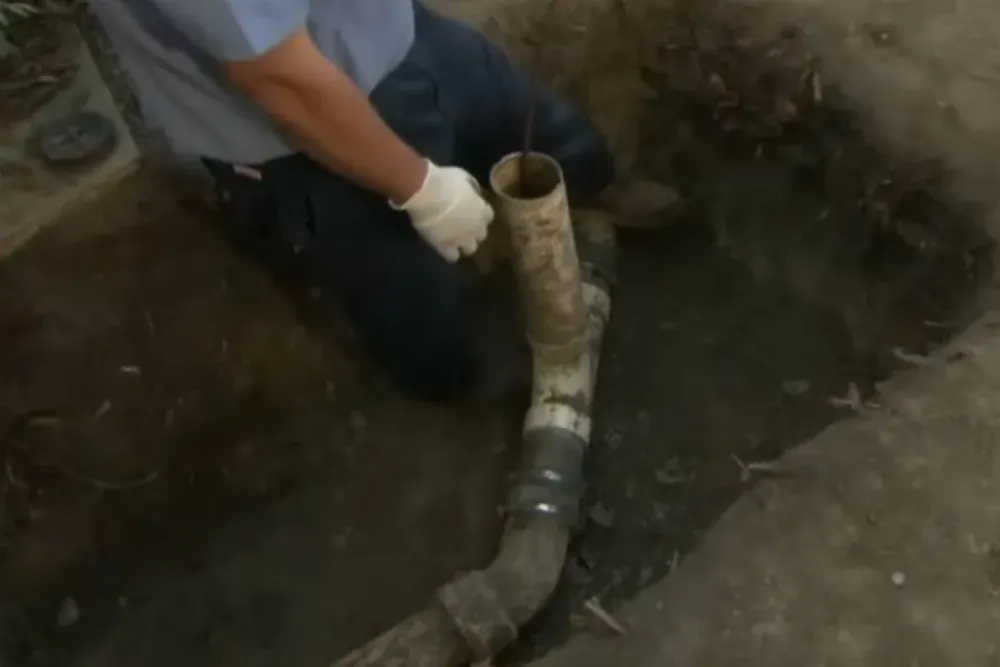
How cast iron drain pipe wears out
Cast iron is tough, which is why it stayed in houses for generations. It wears out from the inside. Wastewater is mildly corrosive, and over the decades the pipe wall flakes into rust scale and grows rough nodules. Paper, grease and wipes catch on that rough surface, and the opening gets narrower each year.
The outside can fail too. Cast iron buried under a slab or in damp soil can rust through from the outside, and a joint can leak long before the pipe itself breaks. Slow drains that return within weeks of cabling are the usual first sign.
Symptoms that point to a failing cast iron line:
- Several drains slow down together, not just one fixture.
- A main line clog returns soon after it is cleared.
- A sewage odor near a floor drain or along a basement wall.
- Rust-colored stains or flaking scale on exposed pipe.
- Gurgling from the tub or toilet when the washer drains.
How pipe lining works, step by step
The method is often called cured-in-place pipe. The sequence is the same on most jobs, and each step matters to the result.
- Camera inspection. A camera runs the full length of the line first. It shows the pipe diameter, the scale, any cracks, and whether a section has dropped or separated. See our notes on sewer camera inspection for what the footage can and cannot show.
- Cleaning the pipe. The scale has to come out before a liner can bond. Jetting or mechanical descaling leaves a clean, rough-textured wall.
- Resin and liner. A flexible felt tube is soaked in epoxy resin, pulled or inverted into the pipe, then pressed against the old wall with air or water pressure.
- Curing. The resin hardens with hot water, steam or ultraviolet light. Curing takes hours, and the line stays out of service during that time.
- Reopening and a final camera pass. Branch connections are cut open from inside, and a second camera run confirms a smooth, continuous lining before the line goes back to use.
Lining, spot repair or full replacement?
Each option fits a different condition of pipe. The camera footage tells us which row you are in.
| Pipe condition | Best option | Trade-off |
|---|---|---|
| Scaled and rough, round, no breaks | Full-length lining | Slightly smaller inside diameter, no digging |
| One cracked or separated joint, rest sound | Spot repair or short liner patch | Leaves the rest of the old pipe in service |
| Collapsed, crushed or sagging section | Dig and replace that section | Needs excavation and a permit. See sewer line repair |
| Heavy offset at a joint | Dig and replace | A liner follows the offset instead of straightening it |
| Unknown condition | Camera first, decide after | A small cost that avoids paying for the wrong repair |
What lining cannot fix
A liner is a pipe inside a pipe. It copies the shape of whatever it is pressed against, so a belly that holds water stays a belly. A pipe that has collapsed cannot be reached by the liner tube at all.
Lining also reduces the inside diameter by a small amount. In a four-inch drain that trade is usually fine, because the new surface is smooth and flows better than the scaled iron it covers. In a very small branch line it can matter, which is another reason the camera comes first.
Active roots need to be cut out before lining, and a line with a hidden offset may call for excavation anyway. A plumber who tells you lining is the answer before seeing the footage is guessing.
Milford, MA: older pipes, the town sewer and permits
Milford was incorporated in 1780, and the town began treating wastewater in 1906, so the housing stock includes homes old enough to have original drain pipe. Houses from the early twentieth century are where cast iron under floors and in basements is most likely to be found. A camera, not a guess about the year built, tells you what your pipe actually is.
The town runs its own sewer plant and the mains under the street. The pipe from your foundation out to that main is usually the owner's. Before planning any repair near the curb, call the town Sewer Department, (508) 473-2054, and ask where that line is drawn on your street.
Under Massachusetts rules, work on sewer, drainage or vent piping is not a minor repair, so it needs a permit pulled by a licensed plumber and an inspection. Town Hall can put you in touch with the plumbing inspector about how a liner is handled. If digging is needed, call 811 before anyone breaks ground.
Lining a drain is an alteration of drain piping under the Massachusetts plumbing code (248 CMR), so the guideline is a licensed plumber, a permit and an inspection.
What affects the price of lining cast iron
Lining is priced by the job, with a clear price given before any work starts. These factors drive the number:
Most homeowner policies treat gradual pipe wear as maintenance, not a covered loss. Sudden damage may be handled differently, so read your policy before assuming a repair is covered.
Want the real number for your line? Call (508) 389-4045 and tell dispatch what the drains are doing.
Do you need a licensed plumber for this?
Yes. In Massachusetts, only a licensed master or journeyman plumber may do plumbing work, and permits for it go only to licensed plumbers. You can check any plumber's license with the Board of State Examiners of Plumbers and Gas Fitters, and you should ask for the scope and price in writing.
Be careful with anyone who offers a quick spray-on fix without a camera. Ask for the footage before and after the lining, and ask who pulls the permit. If you live in a neighboring town, the same state rules apply, and neighbors in Hopedale and Mendon ask us the same questions.
Lining cast iron pipes: Milford homeowner questions
Makers of cured-in-place liners describe them as long-lived, often rated for decades, but the real life depends on installation quality and the condition of the host pipe. Ask the plumber what warranty comes in writing and what it covers.
Roots must be cut out first, and the pipe has to be cleaned back to a solid wall. If the roots entered through a broken joint, the liner seals that joint as well, which is one of its main strengths.
If the odor comes from a leaking joint or a cracked wall, a liner can seal the leak. If the smell comes from a dry floor drain trap, refilling the trap with water is the fix instead.
Yes. Without footage, nobody knows the length, the diameter, the number of branches or whether a section has collapsed. Skipping it risks paying for a liner that cannot be installed.
The town Sewer Department, at (508) 473-2054, can tell you where the town main ends and your own line begins. We handle the pipe on your side of that boundary.
No. Liner installation needs specialized equipment and a licensed plumber who holds the permit. In Massachusetts, work on sewer and drainage piping is not a minor repair.
Not sure what your drain pipe is made of? Call (508) 389-4045 and describe the symptoms. We will tell you whether a camera check is the right first step.