
Symptom guide: what the heater is telling you
Most heater faults announce themselves. This table pairs the common symptoms with the usual cause, so you can describe the problem accurately on the phone.
| What you notice | Likely cause | Typical fix |
|---|---|---|
| No hot water, gas unit | Pilot out, bad thermocouple or dirty burner | Relight and test, replace the sensor, clean the burner assembly |
| No hot water, electric unit | Tripped breaker, failed element or bad thermostat | Reset the breaker, test and replace the failed part |
| Lukewarm water only | One of two elements dead, or a sediment-buried burner | Replace the element or flush the tank and clear the burner |
| Popping or rumbling sounds | Sediment layer baking on the tank bottom | Flush the tank, and replace it if the scale is heavy |
| Water dripping from a pipe near the top | Loose or worn connector, or a leaking relief valve | Tighten or replace the fitting or valve |
| Water pooling under the tank | Possible corroded tank | Find the source. A rusted tank means replacement |
Water around the heater right now
A damp floor needs a quick look before anything else, because the source decides everything. Dry the area with a towel, then watch the base and the pipes for a minute. A drip that forms on a fitting is a repair. Water that appears from under the jacket insulation means the tank is going.
We send a plumber to active leaks at any hour, and a standard repair part is often on the truck so the fix can finish on the same visit. If the part has to be ordered, the plumber can make the heater safe and tell you when the second visit is.
While you wait, protect the house:
- Shut the cold water valve above the heater. If it will not turn, shut the main valve where the water enters the house.
- Gas unit: set the control knob to off. A smell of gas means leave and call your gas utility or 911 first.
- Electric unit: turn off the breaker only if you can reach the panel without standing on a wet floor.
- Do not remove the relief valve or cap its discharge pipe. That valve is the last safety device on the tank.
- Put a bucket under a dripping fitting and move anything stored near the unit.
Gas heaters: pilot, igniter and thermocouple
A gas heater needs three things to make hot water: gas, a flame to light it, and a sensor that proves the flame is there. If the pilot light blows out, the sensor, called a thermocouple, shuts the gas off. Relighting it works once. If it goes out again within days, the thermocouple is weak or a draft is reaching the burner.
Newer units have an electronic igniter instead of a standing pilot. A blinking status light is the unit's own error code, and the label on the tank explains it. We read the code, test the part, and replace what failed.
A heater that smells like gas or leaves soot on the burner area is a different matter. We shut it down and test the draft and venting before it runs again. Burner work on an oil unit goes to a licensed oil burner technician.
Electric heaters: elements and thermostats
Most electric tanks have two heating elements, one high and one low, each with its own thermostat. When the upper element fails you get no hot water. When the lower one fails you get a short supply of hot water that runs out fast.
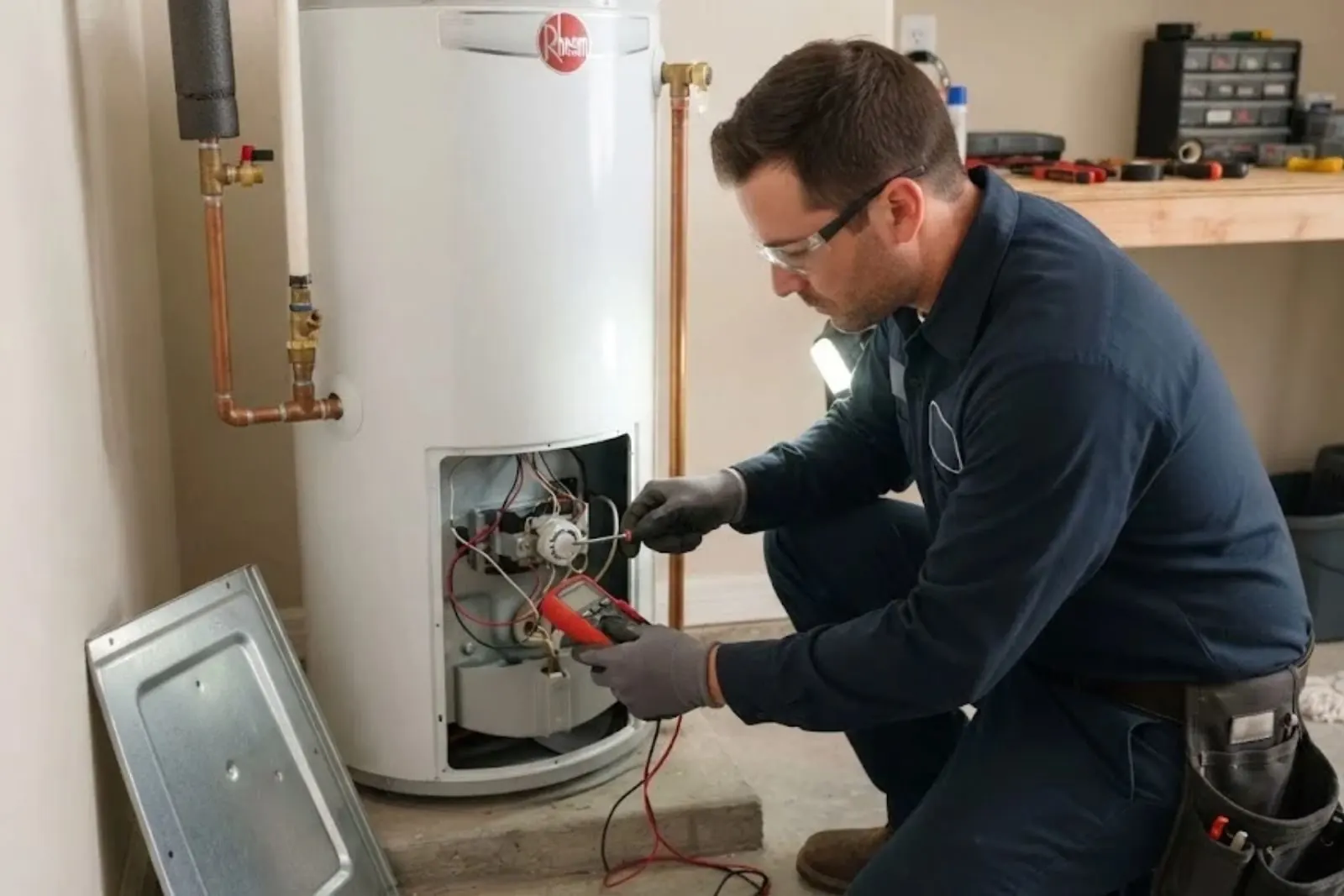
The plumber checks power at the terminals, tests each element with a meter, and swaps the one that has failed. Elements are cheap compared with a tank. They still need the tank drained first, and that is why a repair visit can take a couple of hours.
A high-limit reset button on the upper thermostat trips when the water gets too hot. If it trips again after you reset it, the cause is a bad thermostat or a stuck element, not a nuisance trip.
Tell dispatch the fuel type and what the tank is doing. Same-day appointments are available when the schedule allows.
The temperature and pressure relief valve
Every tank has a T&P valve on the side or top, with a pipe running down toward the floor. It opens if the water gets too hot or the pressure climbs too high. A valve that drips constantly may have a worn seat, or it may be doing its job because pressure in the house is running high.
This is where an expansion tank often comes in. In a closed system, heating the water has nowhere to go, and the pressure spikes. We measure the pressure first, then decide whether the valve or the system needs the fix. Replacing the valve alone will not cure a pressure problem.
Never plug the relief pipe
If hot water drips from the discharge pipe, do not cap it. A blocked valve on an overheated tank is how heaters rupture. Call us.
Rumbling, popping and rusty water from sediment
Minerals and loose rust settle to the bottom of a tank over the years. The burner or element then heats the sediment layer, and trapped water flashes to steam beneath it. That is the popping you hear.
A flush clears it when caught early. A thick, stone-hard layer does not rinse out, and by then the tank is usually near the end of its service life. Rust-colored hot water only, with clear cold water, points to the tank or the anode rod rather than the house pipes.
The anode rod is a sacrificial metal bar that corrodes in place of the tank steel. Checking it every few years extends tank life. Once it is gone, the tank wall takes the attack instead.
Milford, MA: treated water and what settles out
Milford Water Company removes iron and manganese from its supply, and that treatment keeps most of those minerals out of your pipes. What it cannot tell us is how much sediment your particular tank has collected, which depends on age, usage and any private filter you added.
Hardness differs from tap to tap, so test yours. If your heater sounds like popping popcorn, ask the water company for its yearly Consumer Confidence Report, test your tap, and have the tank flushed. A flush that runs clear is a good sign, and one that runs gritty tells you what the next repair will be.
Why one repair costs more than another
The plumber diagnoses first and quotes second. Four things drive the number:
Wear and tear on a heater is rarely an insurance claim. Water damage from a sudden failure sometimes is, so photograph any wet area before you clean it.
Want an honest figure? Call (508) 389-4045 and describe the fault.
Water heater repair questions answered
Yes. A leaking tank or a relief valve that will not stop running is treated as an emergency whatever the hour. A heater that is only cold can usually be booked as a same-day visit, or the first slot the next morning if it is late.
A pilot that keeps dying usually means a worn thermocouple, a draft, or dirt in the pilot tube. Relighting it is a short-term fix. Testing the sensor and cleaning the assembly stops the repeat.
On an electric heater one of the two elements may have failed. On a gas heater a sediment-covered tank bottom blocks the heat. A mixing valve or crossed pipes can also be the cause, which the plumber checks.
Not without checking it. The valve may be reacting to too much pressure or heat. The cause needs diagnosis, and the discharge pipe must never be capped.
Fixing a working part of an appliance can count as a minor repair, but replacing a valve or any work on supply or vent piping does not. The Milford plumbing inspector, reached through Town Hall, can confirm what applies.
Milford Water Company removes iron and manganese and adjusts the water to protect pipes, but hardness still differs from tap to tap. Read the yearly report or test your tap, and flush the tank if it rumbles.
Dry everything, then watch. Drips starting at a pipe joint or valve are a repair. Water that comes out from the bottom of the jacket or a seam on the tank means the tank has failed.
Not sure if it is the pilot, the element or the tank? Call (508) 389-4045, say what you see and what you smell, and dispatch will tell you what to shut off before the plumber arrives.
If the heater is past saving
When a diagnosis ends in a rusted tank, the water heater installation page explains planning, and tankless water heater service covers the on-demand route. A leak that is not from the heater at all may need leak detection, and a heater room that shares a flue with a boiler may call for boiler repair. Neighbors in Bellingham use the same dispatch line.