
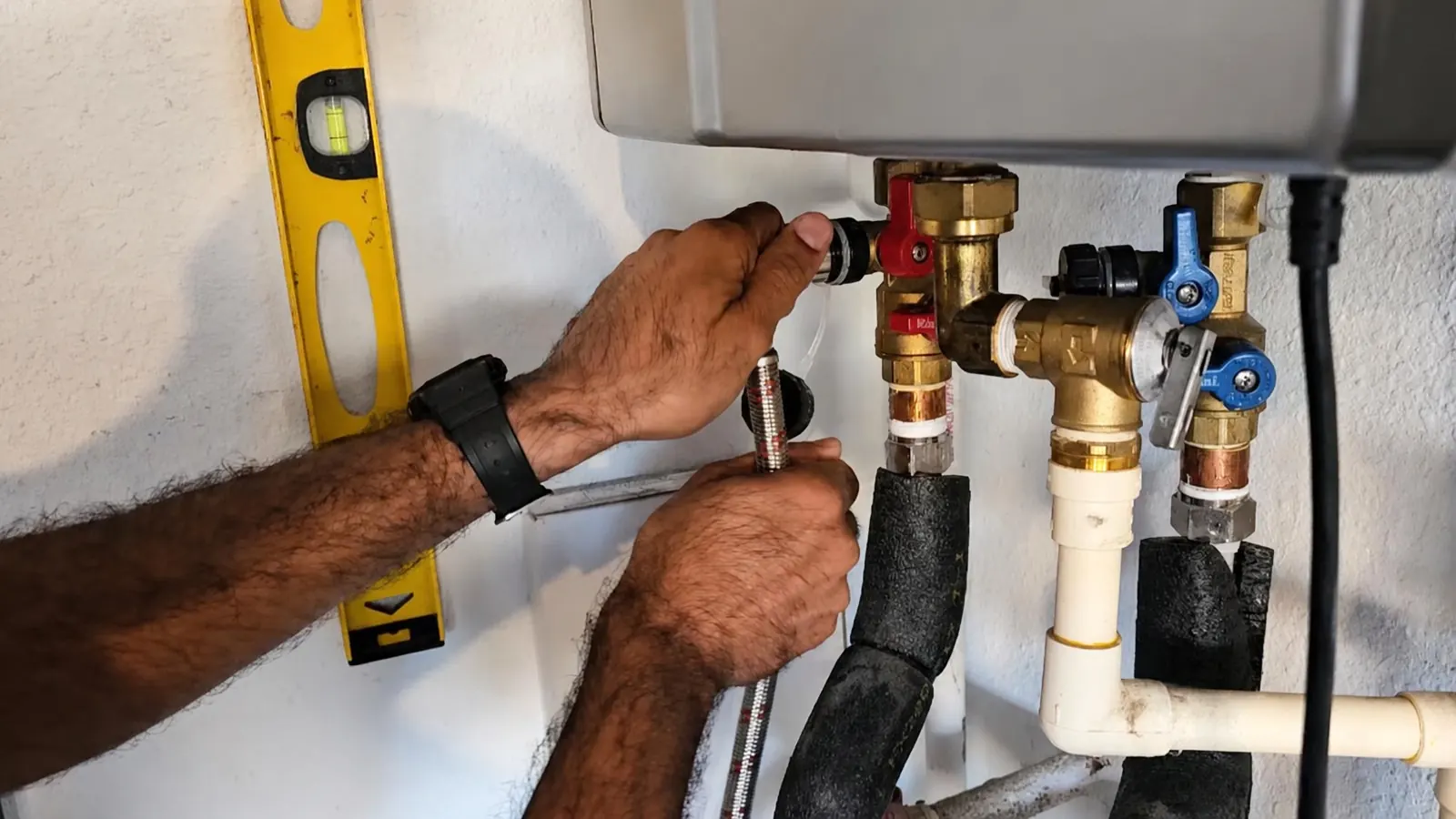
How an on-demand heater works, and what that means for you
When a hot tap opens, a flow sensor tells the unit to fire a burner or switch on heating elements. Cold water passes through a heat exchanger and leaves hot. Close the tap and the unit stops. Nothing sits in a tank losing heat.
That design explains both the benefits and the complaints. Hot water does not run out during a long shower. You also get a short delay while the unit starts, and a minimum flow is needed before it fires. A very slow trickle from a low-flow faucet can leave you with a cold or lukewarm stream.
Gas or electric tankless: choosing the fuel
The fuel decides the installation work more than any other choice.
| Gas tankless | Electric tankless | |
|---|---|---|
| Output | High flow, can serve several fixtures at once | Usually lower flow. Whole-house units need a lot of power |
| Installation | Gas line often needs upsizing, plus a sealed vent through a wall or roof | No vent, but needs a heavy dedicated circuit and often a panel upgrade |
| Best fit | Larger households, several bathrooms | Small homes, one bathroom, or a point-of-use unit near one fixture |
| Main trade-off | Venting and gas capacity can raise the project cost | Electric service capacity can limit what is practical |
Flow rate and temperature rise: the numbers that decide success
Every tankless unit is rated in gallons per minute at a given temperature rise. In winter, incoming water is colder, so the same unit delivers less hot water than the label suggests for the warmest months. Size for the coldest incoming water, not the average.
Add up the fixtures that may run together. A shower, a dishwasher and a running faucet each draw a few gallons per minute. If the total beats the unit's rating, the temperature drops. Larger homes sometimes use two units or add a recirculation line to cut the wait.
Retrofitting into a house built for a tank
A house piped for a tank needs changes. Swapping in a tankless unit changes three things. The gas line is often too small, because a tankless burner demands far more gas at once than a tank burner. The vent is different, usually sealed plastic or stainless pipe through a side wall. And the unit needs an electrical outlet and sometimes a condensate drain.
A licensed plumber handles the water and gas side with a permit. Electrical upgrades go to a licensed electrician. We check the gas capacity before quoting, since a line that cannot deliver enough gas is the most common reason a retrofit gets more expensive.
If you smell gas
Leave the house and call your gas utility or 911 before anything else. Do not switch lights on or off on the way out.
Call and tell us the fuel, the number of bathrooms and where the current tank sits. We will say whether it fits.
Descaling and annual maintenance
Mineral scale builds on the heat exchanger and narrows the passages. Symptoms are rising error codes, a slow drop in output and a unit that cycles on and off. Flushing the heat exchanger with a descaling solution clears it and is the main service task for these heaters.
A yearly service also cleans the inlet screen, checks the vent for blockage or corrosion, tests the flame or elements and reads stored error codes. How often you need descaling depends on your water, which is why a once-a-year habit is a sensible start.
Signs a tankless heater needs service now:
- A fault code shows on the display.
- Hot water is weaker or cooler than last winter.
- The unit cycles on and off during a long draw.
- You hear a kettle-like whistle or rumble.
- Water temperature swings during a shower.
Milford, MA: your water decides how often to descale
Milford Water Company treats supply from the Charles River, Echo Lake and several wellfields, but hardness differs from tap to tap and only a test of your own water settles it. That figure is what sets the pace of scale in a heat exchanger.
The practical step is simple. Request the yearly Consumer Confidence Report from the water company, test your tap, and tell the plumber the result. If you already own a unit, check the error history after the first year and set the descaling schedule from that.
Venting and gas piping for a tankless unit are regulated work, so a licensed plumber with a permit follows the Massachusetts plumbing code (248 CMR) and the manufacturer's installation guidelines.
Honest trade-offs
A tankless unit usually costs more to buy and install than a tank of similar capacity. It can last longer, though that depends on the maintenance it gets. Running costs depend on your fuel and use, so the saving is not automatic.
It may not suit a household that wants hot water at several distant fixtures within seconds, or a house where the gas supply or vent route is hard. If your tank is leaking, the water heater replacement page covers a faster path, and the water heater installation page compares all fuels.
What affects the price of tankless work
We give a clear price before work starts. The usual factors are:
A new heater is an upgrade you pay for yourself, not an insured loss. Your gas or electric utility may run efficiency rebates, so ask whether any efficiency rebates apply.
Call (508) 389-4045 for a real figure on your house.
What to do if a tankless unit shows a fault or smells of gas
A gas smell is the one fault that does not wait. Leave the building, do not touch switches, and call your gas utility or 911 from outside before you call us.
For an error code with no smell, turn the unit's power off at its switch, wait a minute and restart it once. If the code returns, leave it off and call, because repeated restarts can overheat a clogged heat exchanger.
Safety guidance for any fuel-fired water heater:
- Keep the area around the unit and its vent clear of boxes and chemicals.
- Never block a vent or intake with insulation or storage.
- Test the carbon monoxide alarm on the same floor.
- Shut off the cold supply if the unit leaks, then call.
Tankless water heater questions
Only up to its flow rating. One shower never runs out, but too many fixtures at once can exceed the rating and drop the temperature. Size the unit to your peak use, not to a headline claim.
Sometimes. Tankless burners use much more gas at once, so the pipe and meter capacity must be checked. If the line is too small, upsizing is a common extra.
It depends on your water. Many homeowners start with a yearly service and adjust from the error history. Ask the water company for its report and test your tap.
Water already in the pipes cools, the unit restarts and some residual cold water passes through. A recirculation loop or point-of-use unit reduces it.
Yes. Installing or replacing a water heater is plumbing work, so the plumbing inspector issues a permit first. Only licensed plumbers can pull it. Town Hall can point you to the Milford plumbing inspector.
Hardness differs from home to home. The water company publishes a yearly report, and a home test kit shows what is at your tap. Descaling is the main defense either way.
Not sure if your gas line or vent can handle it? Call (508) 389-4045, describe the setup, and we will say what to check.
Related work
A unit that has stopped working altogether is covered on the water heater repair page. Gas and venting changes sometimes go hand in hand with plumbing installation work, and homeowners in Mendon who use private wells should mention the well when they call, since well water behaves differently inside a heat exchanger.