
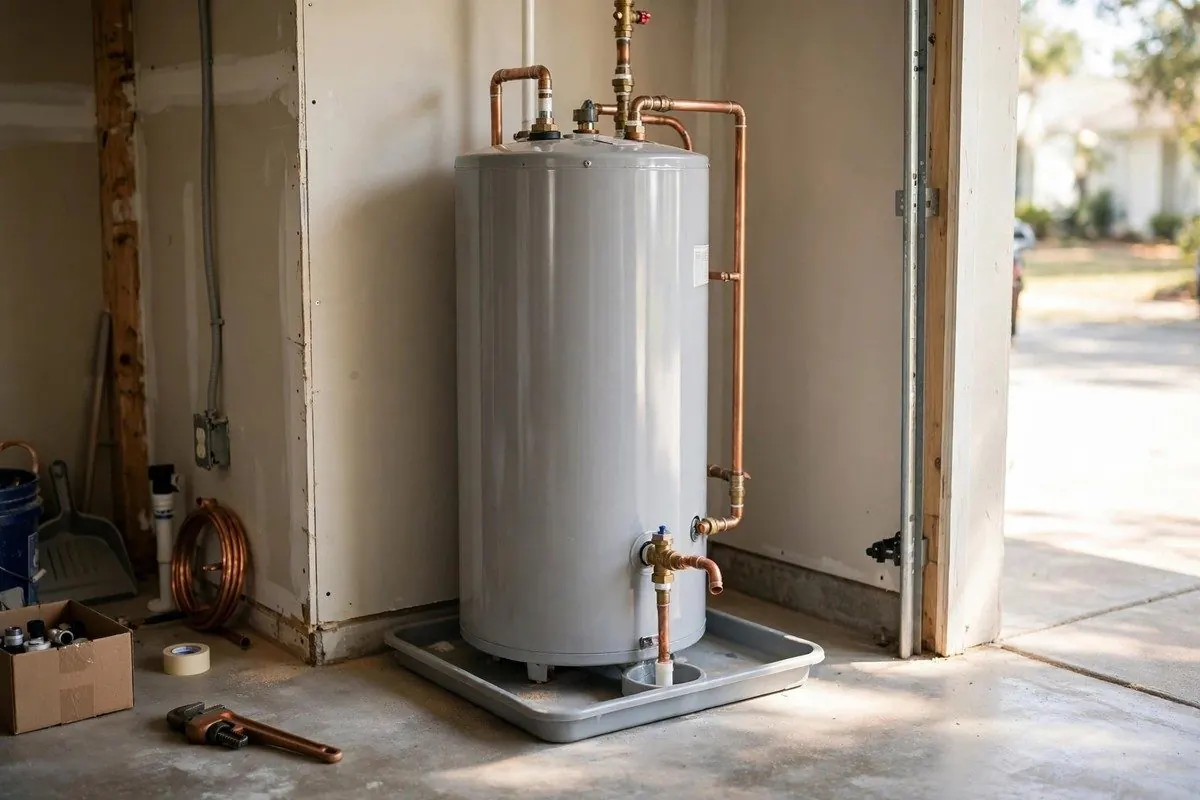
A leaking tank is not the same as a leaking pipe
Water under a heater has two very different sources. A drip from a fitting on top, a supply connector or the relief valve discharge pipe can often be repaired. Water seeping from the bottom of the jacket or the seam of the tank means the steel liner has rusted through, and no patch will hold.
A failed tank can release the whole contents, roughly 40 to 50 gallons for a typical home unit, and it can do it slowly or all at once. A tank failure at midnight gets sent out just like one at noon, and in most cases the new heater goes in on the same visit when the unit is in stock.
Do these while you wait for the plumber:
- Close the cold supply valve on the pipe entering the top of the tank. Turn the handle a quarter turn if it is a lever.
- Gas heater: turn the gas control knob to off. A gas smell means you walk outside first, then phone the gas utility or 911, and only then call us.
- Electric heater: switch off its breaker, but only if the panel is dry and you can reach it without stepping in water. If not, stay clear and tell dispatch.
- Open a hot tap upstairs to let the pressure drop, and move boxes and stored items off the wet floor.
- Do not touch hot water or a pipe that feels scalding. Water in the tank can be hot enough to burn skin.
No hot water at all: is the tank dead or just tripped?
Cold taps from a heater that worked yesterday do not always mean replacement. On an electric unit, a tripped breaker or a failed element can stop heating. On a gas unit, a pilot that blew out or a worn thermocouple does the same.
Replacement becomes the sensible answer when the tank itself is failing: water at the base, a heater that rumbles loudly from scale, rust-colored hot water, or repeated repairs on a unit that is well past a decade old. For anything cheaper, our water heater repair service is the first stop, and the plumber will tell you honestly which side of the line your unit is on.
Replace or repair: how the decision usually falls
Age, location of the problem and the cost of the fix decide this. The plumber checks the data plate for the build date and walks through the options with you before any work starts.
| Situation | Usual answer | Why |
|---|---|---|
| Water leaking from the tank body or base | Replace | A corroded steel tank cannot be sealed. The leak will return or get worse. |
| Unit around 10 to 12 years old with a failed part | Often replace | Parts are cheap next to a tank that may fail months later. Ask for both options. |
| Unit under about 8 years old, bad thermostat or element | Repair | The tank is sound and the failed part is a straightforward swap. See repair. |
| Leak at a supply connector or relief valve | Repair | The fitting is replaced and the tank stays in service. |
| Gas unit with rusted flue or failed burner assembly | Usually replace | Combustion safety matters more than the cost of the part. |
| Household has outgrown the tank | Replace with a larger size | Repair does not add capacity. See sizing below. |
Choosing the size of the new tank
Tank size follows how many people shower, run the dishwasher and wash clothes close together. A 40-gallon tank suits a couple or a small family. A 50-gallon tank handles three to five people. A 75-gallon unit or a high-recovery model is for larger households or two bathrooms in heavy use.
Two numbers matter more than the sticker volume. The first-hour rating tells you how much hot water the unit delivers in a busy hour. Recovery rate tells you how fast it refills. A gas heater recovers faster than an electric one of the same size, so a 40-gallon gas tank can feel larger than a 50-gallon electric one.
If the old tank always ran out, say so. Changing size is a free decision at the moment of replacement and an expensive one later. The footprint matters too, because a taller or wider tank may not fit the closet or the existing venting.
Tell dispatch what you see at the base of the heater and whether it runs on gas or electric. We will book a same-day visit when available.
Gas, electric and oil: what the swap involves
The easiest swap is like for like. A gas heater is replaced with a gas heater, and the existing gas line, shutoff and vent are reused after inspection. An electric heater is replaced with an electric one on the same circuit, as long as the wiring and breaker size match the new unit's label.
Switching fuel is a bigger project. Moving from electric to gas needs a gas line run to the heater and a vent that carries exhaust outdoors. Moving from gas to electric needs a dedicated circuit, which is electrical work for a licensed electrician. Oil-fired water heaters need a licensed oil burner technician for the burner side of the job.
Many replacement jobs also involve the vent. A new gas heater may be a different type than the old one, and a vent that suited the old tank can be undersized, corroded or poorly pitched for the new one. The plumber checks this at the start, not after the old tank is already out.
Gas safety limit
A suspected gas leak is not a plumbing call first. Leave the building and call your gas utility or 911. We can start work after the utility confirms the house is safe.
How a same-day replacement runs
An emergency swap usually follows this sequence from arrival to a hot tap.
- Shut down and assess. The plumber stops the leak, reads the data plate and checks the venting, gas line or wiring, shutoff valves and floor drain or pan.
- Agree the price. You get the option or two that fit, with a clear price before work starts. Nothing is removed until you say yes.
- Drain and remove. The old tank is drained to a drain or outdoors, disconnected and carried out.
- Set and connect. The new heater is set level, supply lines, relief valve and discharge pipe are connected, and an expansion tank is added where the system needs one.
- Fill, fire and test. The tank is filled with the hot tap open to purge air. Then power or gas goes on, the burner or elements are checked, and every joint is tested for leaks.
- Permit and walk-through. The plumber files the permit and shows you the shutoff valves, the relief valve and where to set the temperature.
Permit and inspection for a replacement
In Massachusetts, replacing a water heater counts as plumbing work, so a permit comes first and an inspection follows. The state issues these permits only to licensed plumbers, so an installer who cannot produce one is a red flag.
A permit also means a second set of eyes on the relief valve, the discharge pipe and the venting. Town Hall can tell you how the local inspector handles your address. The town posts a warning about fraudulent permit-fee emails and texts, so pay permit fees only through the town's official channels.
Milford, MA: water treatment and your tank
Milford Water Company blends surface water with wellfield groundwater, takes out iron and manganese, and doses potassium hydroxide and zinc orthophosphate so pipes corrode less. That treatment protects the plumbing, but it does not tell you how much mineral builds up inside a tank.
Hardness differs from tap to tap, so a test of your own water is the useful number. The utility's yearly Consumer Confidence Report is the place to look, and a store-bought kit will test your own tap. If your old tank rumbled and the bottom was packed with scale, that is a reason to flush the new one yearly and to ask about an anode rod check.
What changes the price of a new water heater
Two houses with the same tank can end up with very different totals. Here is what moves the number, and you see it in writing before we start:
A heater that fails from age is usually a maintenance cost. Water damage from a sudden tank rupture may be covered under a homeowner policy, but the unit itself usually is not, so check with your insurer before you throw anything away and take photos first.
Call (508) 389-4045 for a real number for your tank and your fuel type.
Water heater replacement questions from Milford homeowners
Yes. A tank that is leaking at 11 p.m. on a Saturday gets the same dispatch as one at noon on a Tuesday. A unit that has only stopped heating can usually be booked for the next available same-day slot.
A tank heater often lasts about 8 to 12 years, depending on use, water quality and maintenance. The build date is on the data plate. A unit near the end of that range that starts leaking is a replacement, not a repair.
A standard like-for-like replacement is usually a half-day job once the plumber is on site, followed by a heat-up period before the tank is fully hot. Fuel changes and vent work take longer.
Yes. Replacing a water heater is plumbing work, and the local plumbing inspector must issue a permit before it is done. Only licensed plumbers can pull plumbing permits. The plumber files it, and the inspection follows.
Stop the water at the cold supply valve, turn off the heater, and keep power off near the wet area if the panel is unsafe to reach. Photograph the damage for your insurer. The plumber stops the source, and drying and cleanup are separate work.
The utility treats for iron, manganese and corrosion, but hardness is something only a test of your own tap can settle. Read the yearly Consumer Confidence Report or test your tap. Sediment in an old tank is the clearest sign that yours collects scale.
Only a licensed plumber can do plumbing work that needs a permit, and a gas connection or relief valve error can be dangerous. The risk is not worth the saving.
Yes. A hybrid unit pulls heat from the surrounding air, so it needs open floor space, airflow around it and a condensate drain, and it runs best in a basement or utility room that is not tiny. The plumber checks those points on the first visit, and the permit step is the same as for any water heater replacement.
Not sure whether you need a new tank or just a part? Call (508) 389-4045 and describe the age, the fuel and what you see. Dispatch can tell you what to check while the plumber is on the way.
Next steps and related work
If you are planning ahead rather than reacting to a leak, the water heater installation page covers fuel choices and planning, and the tankless water heater page explains the on-demand option honestly. A heater near a boiler room may share a flue, so boiler repair questions sometimes come up on the same visit. We cover Hopedale and the surrounding towns from the same dispatch line.