
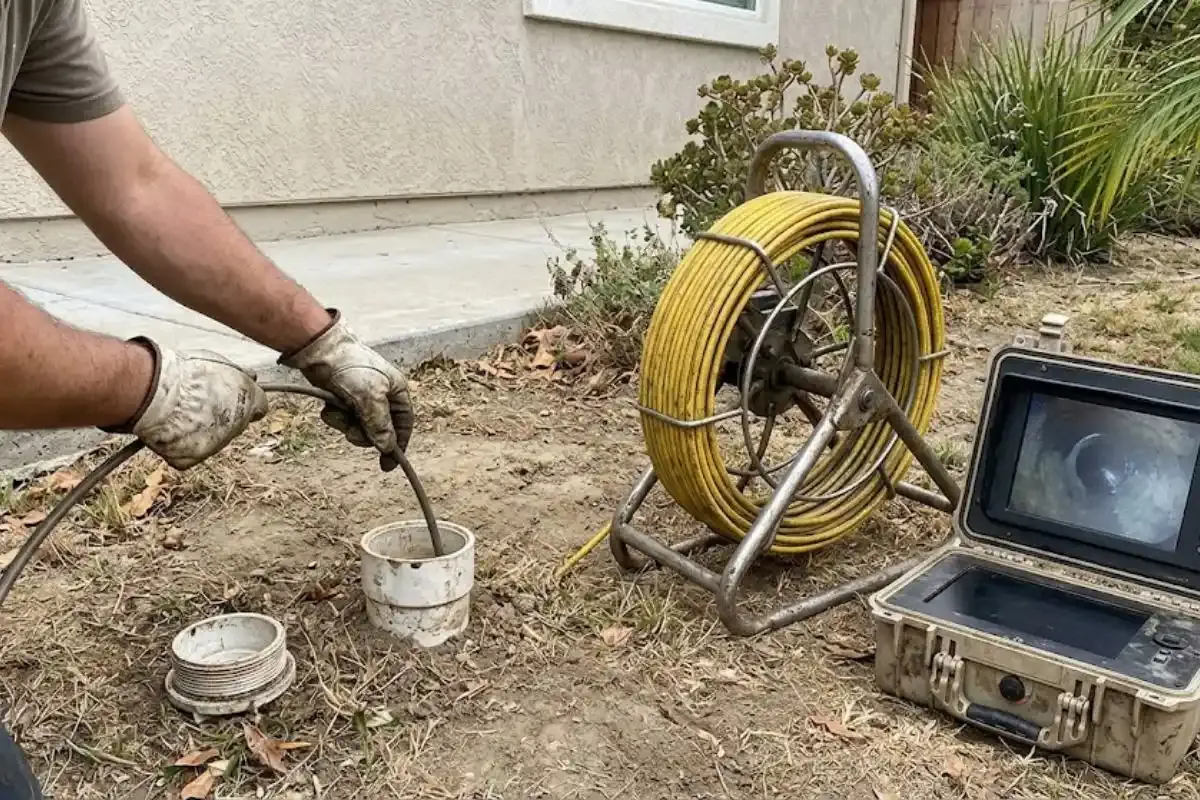
What the camera actually sees
The camera head carries its own light and sits on a flexible push rod. The plumber feeds it in through a cleanout, a pulled toilet or another access point and watches the live image. A built-in transmitter lets the crew trace the camera's position from above ground.
That location signal matters. If the camera finds a break forty feet along the line, the plumber can mark the spot on the surface, which tells you where a dig or a liner would start.
Findings and what they mean
Most footage falls into a handful of patterns. This table shows how each one usually reads on screen and what follows.
| On the screen | What it usually means | Typical next step |
|---|---|---|
| Fine hair-like threads or a thick mat at a joint | Root intrusion | Cut the roots, then seal or line the joint |
| Standing water in a low stretch | A belly where the pipe has settled | Monitor, clean regularly, or repair the section |
| Joint shifted so the pipe edges do not line up | Offset joint | Local repair if the rest is sound |
| Cracks running along or around the pipe | Fracture from age or ground movement | Repair or replace the section. See sewer line repair |
| Flaking rough interior on cast iron | Scale and corrosion | Clean it, and plan for lining or replacement |
| Wet, collapsed or missing pipe wall | Break or collapse | Excavation or trenchless repair after a dig check |
When a camera inspection is the right move
A camera is the diagnostic step, not the repair. It earns its cost when something is unclear.
Book one if any of these apply:
- The same drain has clogged twice in a year.
- Several fixtures are slow and the plumber who cabled the line could not say why.
- A sewage smell comes from a floor drain or the yard.
- A cable got stuck or snagged on something during a cleaning.
- You are buying a home and want to know the state of the lateral before you commit.
- You plan a renovation that adds fixtures to an old line.
Ask for the recording. A saved video lets you compare it with a second opinion or show it to the plumbing inspector.
How the visit runs from start to finish
Expect an hour or two for most homes, longer if access is tight.
- Find the access point. The plumber looks for a cleanout in the basement or yard. If none exists, a toilet may be pulled to reach the line.
- Clear the line if needed. Heavy buildup blocks the lens. The crew may run a cable or jet the line first so the camera sees pipe, not grease.
- Feed the camera through. The camera runs toward the street or tank while the plumber watches and notes distances to each finding.
- Mark any trouble spots. The locator marks the location of a break or a belly on the surface, and the crew records the footage.
- Review and decide. You see the screen and hear the options. A repair price comes before any work starts.
What a camera cannot tell you
A camera shows the inside of the pipe, not the soil around it. It can show a crack but not how far the soil has washed away. It cannot always cross a full blockage, and it sees only the route the rod can travel.
If the line has a sharp bend, a bad offset or a collapse, the camera may stop. That stopping point is itself information, because it tells the crew where the pipe is no longer passable.
A camera also does not replace a pressure test for water supply leaks, which is a different system. For hidden supply leaks, see leak detection.
Call and describe the clogs, smells or backups. Dispatch will tell you what to expect on the visit.
Milford, MA: your lateral, the town main and septic neighbors
Homes on the Milford sewer drain through a lateral to a town main, and the wastewater ends up at the town treatment plant, which discharges to the Charles River. The Milford Sewer Department at (508) 473-2054 can tell you where responsibility changes on your street. A camera helps because it shows exactly how far along the line your problem sits.
In Mendon, there is no town sewer, so a camera runs from the house toward a septic tank. In Bellingham, the DPW Water and Sewer Division handles its mains. Where the line runs in your town decides who you talk to after the inspection.
Pipes laid before modern materials were common are more likely to show scale and offset joints on camera. If a dig is needed, call 811 first.
Ask the Milford Sewer Department which standard it uses for the town main, since a camera report on your lateral only covers the part you own.
What changes the price of a camera inspection
The price is stated before the camera goes in. These factors move it.
Insurers rarely pay for an inspection, since it is diagnostic. If it finds sudden damage, ask your insurer how your policy treats it.
Want a number for your line? Call (508) 389-4045 and describe the symptoms.
Getting ready for the visit
Clear a path to the basement cleanout and move stored boxes. Tell the plumber about past clogs, patched sections and any trees near the line. Do not run the washing machine or dishwasher during the inspection, since extra flow clouds the picture.
If repairs follow, the plumber explains if you are looking at a spot fix, a liner or a replacement. A sewer inspection is the first of those steps, not the last.
Camera inspection questions from Milford homeowners
Most take an hour or two. A short, clear line with a cleanout is quick. A long line, tight access or heavy buildup stretches the visit.
No. The head is small and the rod is flexible. The risk is a fragile or collapsed line, where the crew stops and tells you before forcing anything.
Ask for it before the visit. A recording is useful if you want a second opinion, need to show a repair contractor or have a question for the plumbing inspector.
No work is done on the pipes, so none is needed. A repair or replacement of drain piping does require a permit through a licensed plumber. Ask the Milford plumbing inspector through Town Hall about a specific job.
Yes, especially for an older home. It shows the lateral's condition before you commit, and the video gives you evidence for repair negotiations.
You get options, with the trade-offs explained in plain words. Many findings, such as a root-filled joint, can be handled with a targeted repair rather than a full replacement.
Want to know what is in your line? Call (508) 389-4045 and tell dispatch about the clogs or smells. They can schedule a camera visit and explain what to clear beforehand.