
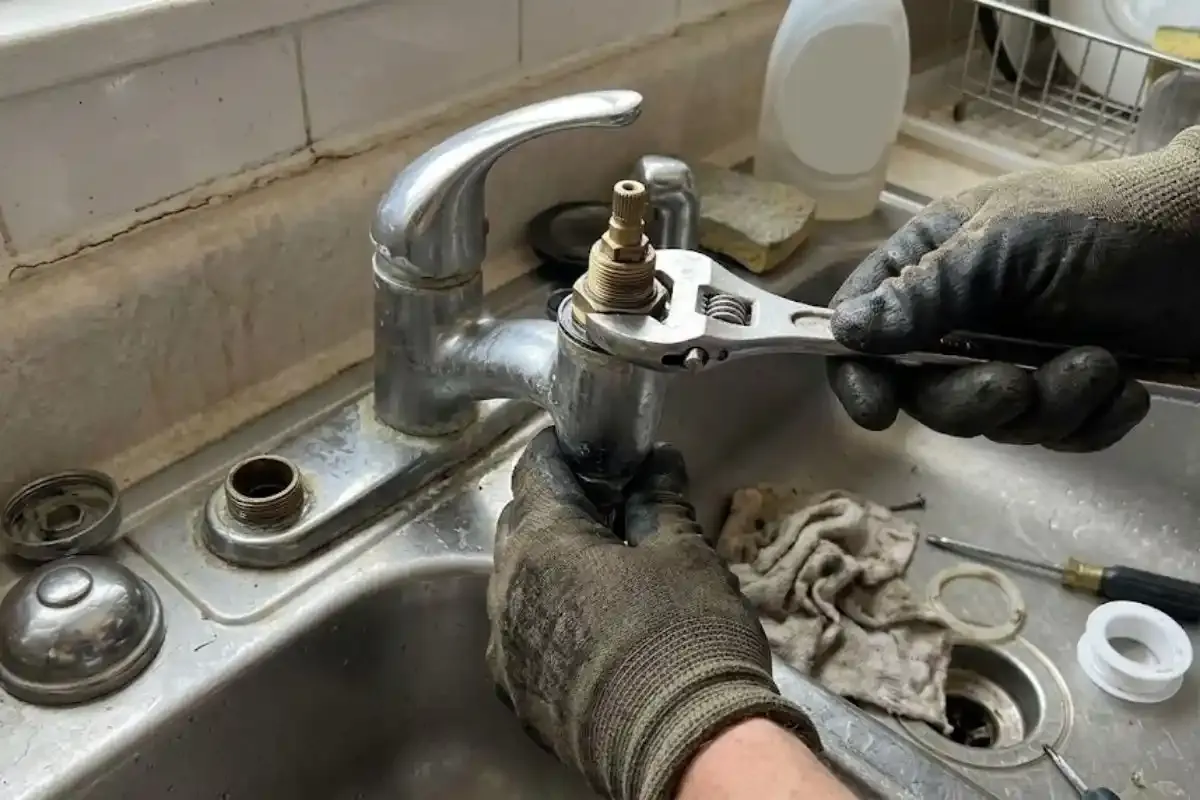
Why a faucet drips in the first place
Every faucet has a part that presses against a seat to stop the flow. Over time that part hardens, cracks or gets scratched by mineral grit, and water slips past it. The drip is often at the spout, and it tends to get worse slowly.
A drip also costs money. A faucet that loses a drop every second adds up to many gallons over a month, and you pay for that water and the sewer charge on it. A small leak is cheap to fix and expensive to ignore.
Match your faucet to the likely failed part
Look at how the handle works and where the water comes from when you turn it. That tells you what is inside.
| Faucet type | How to recognize it | Part that usually wears out |
|---|---|---|
| Compression | Two handles that you turn several times to shut off | Rubber washer and brass seat |
| Ball | Single handle over a rounded cap at the base | Rubber seats and springs, sometimes the ball |
| Cartridge | Single or double handle that moves smoothly | O-rings or the whole cartridge |
| Ceramic disc | Single lever, smooth and heavy feel | Seals in the cylinder, rarely the discs |
If you are unsure, take a photo of the faucet and bring it to a hardware counter. Match the replacement part to the brand and model, because cartridges are rarely interchangeable.
Fixing the drip, step by step
Set a towel in the sink to catch dropped screws, and keep the parts in order as they come off.
- Shut off the water. Turn the two small valves under the sink clockwise until they stop. Open the faucet to release pressure and confirm the flow has stopped. If a valve will not turn, stop and call.
- Remove the handle. Pry off the decorative cap, then undo the screw underneath. Lift the handle straight off.
- Pull the worn part. Unscrew the packing nut or retaining clip and take out the washer, O-ring or cartridge. Note how it sits so the new one goes in the same way.
- Replace and clean. Fit the new part, wipe mineral crust from the seat and rinse any grit out of the body.
- Reassemble and test. Put it back together, open the shutoff valves slowly and run the faucet. Watch the spout and the base for a few minutes.
Tell dispatch what kind of faucet you have and what it does. Same-day appointments are available when the schedule allows.
When the drip is not coming from the spout
Water at the base of the faucet usually means a worn O-ring around the spout. Water under the sink is a different animal. It could be a failing supply line, a loose compression nut or a crack in the faucet body, and wet cabinet floors can hide it for weeks.
If you keep finding moisture and cannot tell where it starts, a plumber can trace it. The leak detection page describes how we find hidden leaks behind a cabinet, under a floor or inside a wall without tearing open more than needed.
Stop and call a plumber if you see any of these:
- A shutoff valve under the sink that will not close or drips when moved.
- Corroded or crusted fittings that crumble as you loosen them.
- A cracked faucet body or a spout that wobbles in the sink.
- A rotten or swollen cabinet floor under the sink.
- A drip that returns within days of a new part.
Repair or replace the faucet
A new cartridge costs far less than a new faucet, so repair is the default. Replacement makes sense when the finish is flaking, parts are no longer made, the body is cracked or you simply want a different style.
Our faucet repair service covers both. A plumber can diagnose the leak, tell you honestly whether a part will hold and price a replacement if it will not. Parts fit differently in each brand, and a wrong part can start a new leak.
Milford, MA: water, mineral buildup and permits
Milford Water Company treats its supply with potassium hydroxide and zinc orthophosphate for corrosion control and removes iron and manganese. Hardness differs from tap to tap, so a quick test of yours is more useful than a town figure. Mineral crust on an aerator or seat is still the most common reason a repaired faucet starts dripping again, and cleaning the seat during any repair helps.
To learn what your water carries, read the utility's yearly quality report and test your own tap. A hard-water result is a good reason to descale aerators and seats each time you open the faucet.
On the rules, Massachusetts treats fixing a leaky faucet or working part of a fixture as a minor repair that needs no plumbing permit. Replacing a faucet or valve does not count as minor, so only a licensed plumber with a permit may do it. For a specific job, ask the Milford plumbing inspector through Town Hall.
According to the state's consumer fact sheet, repairing the working parts of a leaky faucet is a minor repair that needs no permit.
Keeping the new part alive
Close handles gently. Cranking a compression faucet hard against its seat is the fastest way to wear a new washer. Clean aerators every few months, since debris trapped there raises pressure behind the faucet.
Neighbors in Mendon on private wells deal with sediment that scours seats faster, and homes in Holliston have their own water chemistry. Wherever you live, the quickest check is to look at the old washer. A pitted, gritty one tells you the water carries particles.
Dripping faucet questions from Milford homeowners
Yes. A steady drip can waste many gallons a month, and Milford homes on the town sewer pay for sewer service based on water use, so the waste shows up twice. Fixing a drip early costs far less than paying for it for a season.
No. State guidance lists fixing a leaky faucet or a working part of a fixture as a minor repair without a permit. Replacing or relocating the faucet or its valves is not minor, and it requires a licensed plumber with a permit.
The seat the washer presses against may be pitted or crusted, which stops a new washer from sealing. A plumber can dress the seat, or replace the faucet if the damage is too deep.
The process is the same. Kitchen faucets often have a pull-down sprayer with extra seals, so a leak at the hose or the sprayer head needs a different part. Check where the water is appearing before you take it apart.
Hardness changes from tap to tap. Read the utility's quality report and test your tap. If aerators clog with crust, you likely have mineral buildup worth planning around.
Close the shutoff valves under the sink before disassembly. If they will not close, shut the main water valve in the house, and call us. A valve that fails to close should be replaced, not forced.
Not sure which part is failing? Call (508) 389-4045 and describe the faucet and the drip. Dispatch can tell you whether it sounds like a quick repair or a visit.