
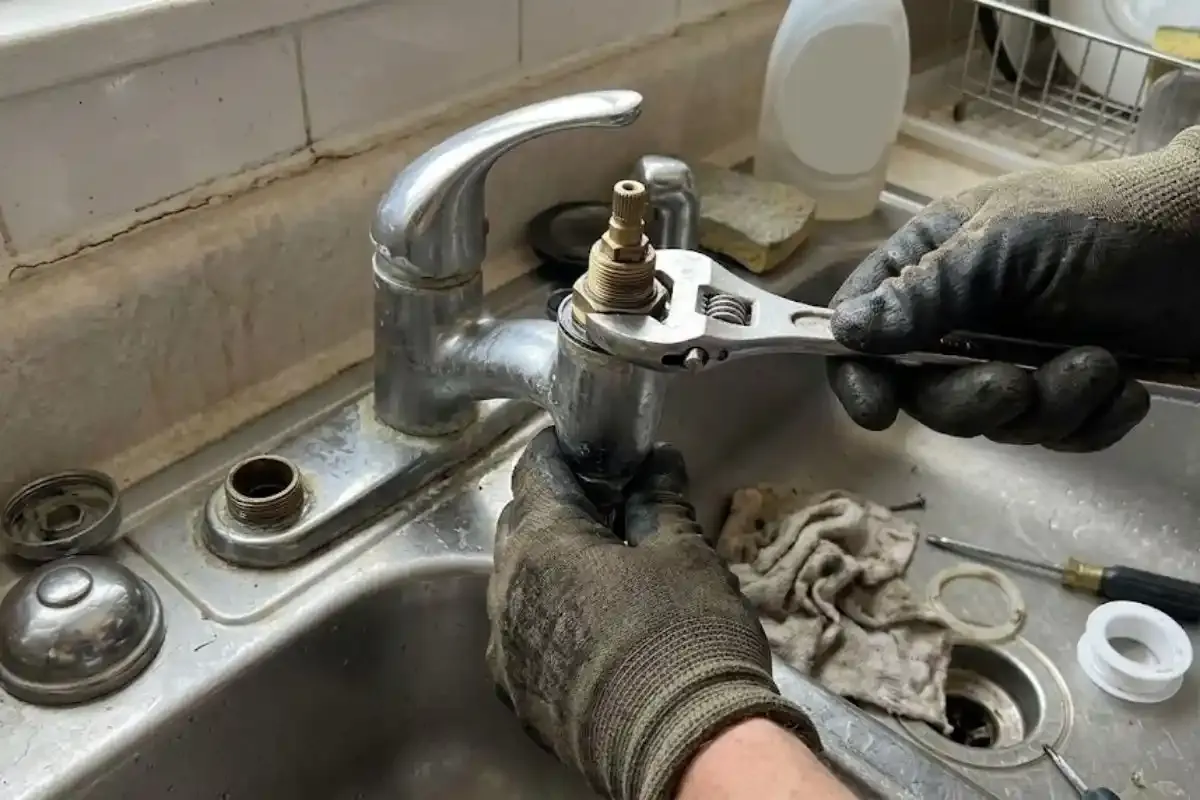
Where the water shows up tells you what failed
Faucets leak in a few predictable places, and each one has its own culprit. Water beading at the spout tip means the seat or the cartridge inside is worn. Water creeping from the base of the handle means an O-ring has hardened. A pool in the cabinet could be the faucet body, a supply line, or the drain trap.
Dry the cabinet floor, then lay a dry paper towel under each connection. The one that turns wet first is where the plumber starts.
Common signs and what they usually mean:
- Steady drip from the spout after the handle is off: worn cartridge, washer or valve seat.
- Handle leaks around its base: failed O-ring or loose packing nut.
- Weak, split or sideways spray: mineral or sediment blocking the aerator.
- Wet cabinet floor and a musty smell: slow leak at a supply line or shutoff valve.
- Water behind the wall or through the ceiling below: stop the water at once and call.
Supply line burst or water spraying under the sink
A braided supply line that fails can pour gallons into a cabinet in minutes. Older lines corroded at the fitting fail most often, and often at night. We dispatch this as an emergency at any hour.
If the two angle stops under the sink will not turn, or they turn and the water keeps coming, go to the main shutoff, usually near the meter in the basement. Once the flow stops, the real repair is easy. The risk is the wet cabinet floor, which swells and rots quickly.
Do this while you wait:
- Turn both angle stops under the sink clockwise. If they fail, shut the main valve.
- Switch off power to a garbage disposal or dishwasher if the cabinet is wet and you can reach the switch dry.
- Empty the cabinet so the floor can dry and you can see the source.
- Do not run the faucet to test it until the plumber has looked.
Cartridge, washer, ball or disc: matching the repair to the faucet
Faucets are built four common ways. The type decides the part and the labor.
| Faucet type | How it fails | Repair |
|---|---|---|
| Compression (two handles, turn many times) | Rubber washer hardens, seat roughens | New washer and seat, often cheap |
| Cartridge (single or double handle) | Cartridge wears and the spout drips | Swap the cartridge and O-rings |
| Ball (single lever kitchen faucets) | Springs and seats wear, base leaks | Rebuild kit with seats and springs |
| Ceramic disc (single lever, smooth action) | Seals or the disc itself cracks | New cylinder, parts can run higher |
Call the 24/7 line. Dispatch will tell you where to shut the water while a plumber is sent.
When to replace the faucet instead
A repair makes sense when the body is sound and parts are easy to find. Replacement is the better call when the finish is peeling, the faucet is badly corroded inside, the spout wobbles on a cracked base, or the manufacturer no longer sells the cartridge.
If you have repaired the same faucet twice, a third repair often costs about what a new faucet does, and our plumber will say which side of that line yours is on. Replacing a faucet is not a minor repair under state guidance, so it is done by a licensed plumber and sometimes with a permit. Adding a new sink or moving a fixture falls under plumbing installation.
What the plumber checks before opening the faucet
First the water is shut off at the fixture and the line is bled so nothing sprays. Then the cartridge or washer comes out and the seat is inspected for pitting, since a pitted seat chews up a new washer in weeks.
The supply lines and angle stops get checked while the cabinet is open. A stop valve that has not been turned in years often fails to close fully, so replacing it first keeps the next repair from becoming a flood.
Milford, MA: what your tap water leaves behind
Milford Water Company supplies the town from surface water and wells, and it filters the water and removes iron and manganese before delivery. Hardness differs from tap to tap, so ask the company for its annual Consumer Confidence Report.
At the faucet, the practical sign is white or brown crust on the aerator and around the spout. Soak the aerator in vinegar to clear it. If crust returns within weeks, a simple home test of your tap tells you more than guessing will.
According to the state's consumer fact sheet, fixing a leaky faucet needs no permit, but replacing or relocating a faucet or valve does.
Why faucet repair prices vary
A clear price comes before the work. These factors set it:
A sudden pipe or supply line failure that floods a home is often covered by homeowners insurance. A slow drip that was ignored usually is not.
Ready for a number? Call (508) 389-4045 and give the brand of the faucet if you know it.
What to do before the plumber arrives
A faucet that is only dripping can wait, but a split hose or a failed shutoff under the sink cannot. Close the small oval valves under the sink first, turning them clockwise until the flow stops.
If the valves will not turn or leak around the stem, close the main shutoff instead and call. Never force an old valve, because a snapped stem turns a drip into a flood.
Safety steps for a leaking faucet:
- Dry the floor and cabinet floor so nobody slips.
- Keep power cords and strips out of the wet cabinet.
- Do not use hot water from a faucet that sprays or spurts.
- Place a bowl or towel under a slow drip and note how fast it fills.
Faucet repair questions people ask in Milford
Yes, around the clock. A faucet that will not shut off or a line spraying under the sink goes out as an emergency, even on holidays. Water is stopped first, then the part is repaired or replaced on the same trip when stock allows.
Yes, quietly. A steady drip adds up to thousands of gallons over a year, shows up on a metered water bill, and stains the basin as it goes.
Swapping a washer or cartridge is a reasonable DIY job if the shutoffs work. If a stop valve will not close, the handle is seized, or you cannot find the model, call. Forcing a seized part can break the body.
Fixing a leaky faucet is a minor repair that needs no permit under state consumer guidance. Replacing a faucet is not a minor repair. Your project's permit questions go to the Milford plumbing inspector.
The aerator at the spout tip is usually clogged with sediment or scale. Unscrew it, soak it in vinegar and rinse. If pressure is low at every fixture in the house, the cause is elsewhere.
We cannot say without a test. Ask Milford Water Company for its annual report, and test your tap for hardness and iron.
Not sure if it is a drip or a failing supply line? Call (508) 389-4045 and describe where the water is collecting.
Related fixtures and drains
A sink that leaks at the drain rather than the faucet may need the work on our drain cleaning page. Kitchen sinks with a disposal share a cabinet, so see garbage disposal repair if that unit hums or drips. A nearby bathroom may need toilet repair too. Customers in Mendon call the same line.