
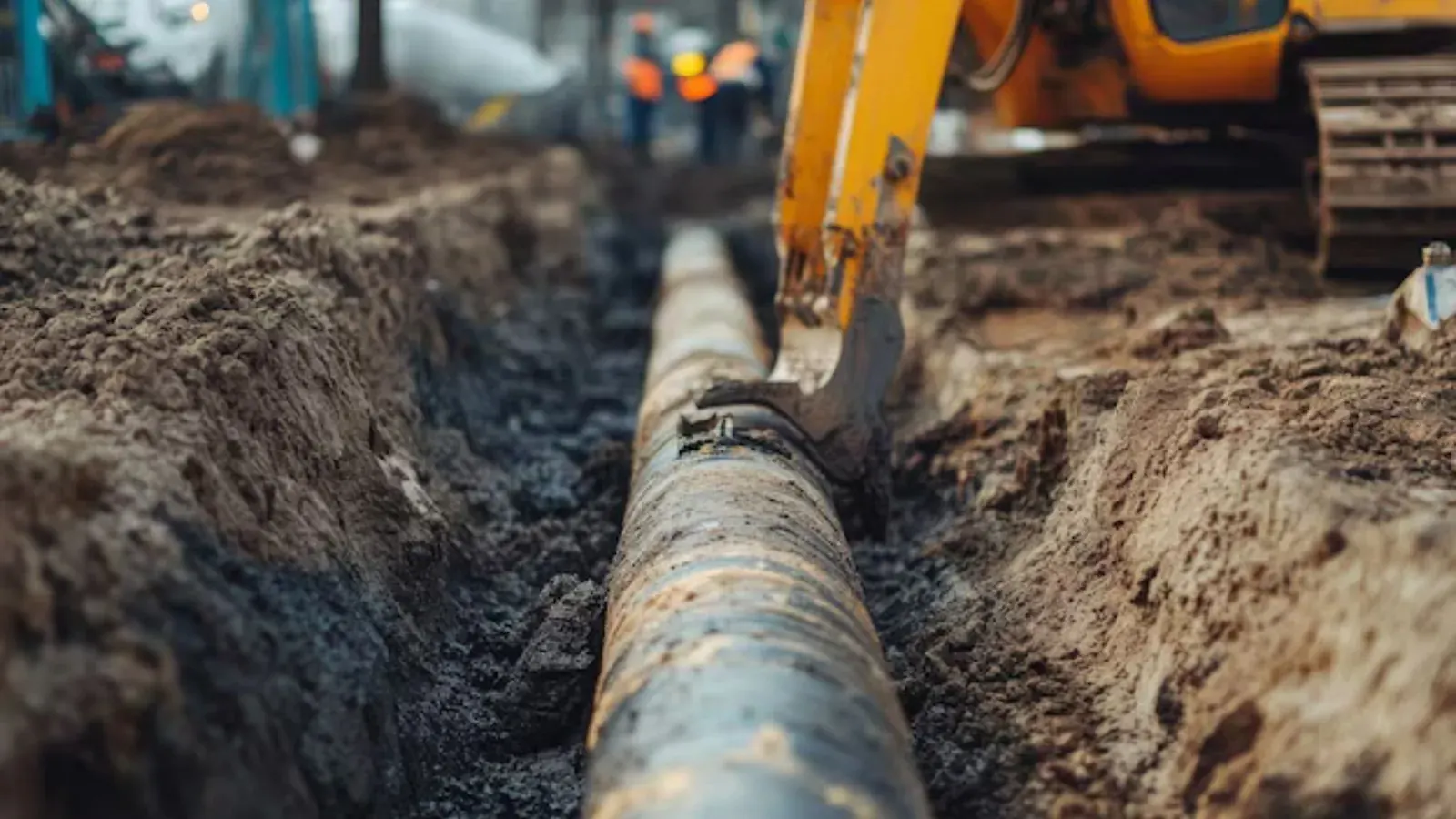
What the service line is and where it runs
The service line is the single buried pipe connecting the water main under the road to your house. It passes the shut-off at the curb or the meter, runs underground below the frost line, and enters the foundation wall, usually into the basement. Inside the house, the first valve you meet is your main shut-off.
Because it is buried, a failing service line gives few warnings. Most homeowners learn about it through a bill, a wet lawn, or a faucet that sputters. Newer plastic and copper lines last decades, but older materials fail sooner, and ground movement or a nearby excavation can crack a sound pipe.
Signs the line under the yard is failing
Watch for changes that happen at the whole-house level rather than at a single faucet. When every fixture slows down together, the problem sits upstream of the branch piping, and the service line is the first suspect.
What homeowners usually notice:
- Low or fluctuating pressure at every tap, hot and cold.
- A wet or spongy patch in the lawn between the street and the house, with no rain.
- A meter dial that spins when every fixture in the house is off.
- Rusty or cloudy water after the line has been unused for a few hours.
- The sound of running water near the wall where the pipe enters.
- A sudden jump in the water bill with no new fixtures or guests.
A second check helps. Close the main valve inside the house and watch the meter. If it keeps running, the leak is on the buried line. Our leak detection page explains how we confirm that.
No water, or water pouring into the yard
A cracked service line can wash out soil, flood a basement window well, or leave the house without water until it is repaired. We treat these calls as emergencies, so night, weekend and holiday calls reach a dispatcher. A frozen line in a cold snap is a common night call.
Whether the problem is a break or an ice plug, the first step is the same: confirm the main valve inside the house is closed, then call. A plumber can usually come the same day to locate the damage and decide on a repair.
Until the plumber arrives:
- Close the main valve inside the house and leave faucets closed once the lines are drained.
- Keep children and pets away from soft ground or a sinkhole above the pipe.
- Do not dig the yard yourself. Dial 811 before anyone digs, because gas, electric and communications lines may be buried nearby.
- If water is entering the basement, move valuables up and stay away from the electrical panel.
Pipe materials in the ground
The material of your service line affects how long it will last and how we repair it.
| Material | What to know | Typical outcome |
|---|---|---|
| Lead | Soft gray metal, scratches bright silver with a key. Seen in very old lines | Replace the line. Lead is a health concern, so ask Milford Water Company about its records |
| Galvanized steel | Rusts inside and narrows over time, reducing flow | Usually replaced, since patches fail again nearby |
| Copper | Long-lasting but can pinhole or crack at joints | Repair a short break or replace the run if multiple spots fail |
| Plastic (HDPE or PEX) | Flexible, resists corrosion, handles ground movement | Repair with a coupling or replace the length |
Who owns which part of the line
Ownership is the question most homeowners ask first. In general, the water supplier owns the main and the equipment it needs, and the property owner owns the pipe from a set point to the house. Where that point sits is decided by the supplier, not the plumber.
Milford Water Company supplies the town and sells water wholesale to sections of Hopedale, Mendon and Medway. Call the company at its office on Dilla Street to ask exactly where your responsibility starts. If your home is in Hopedale or Mendon, your water may come from a town department or a private well, so the answer differs.
Our plumbers work on the owner's section and coordinate with the supplier when the fix touches the meter or the connection to the main.
Phone the 24/7 line now. We can plan a same-day visit to find the break on your buried line.
Repair or replace the line
A decision comes down to the pipe's age, the number of failures, and the cost of reopening the ground a second time.
| Situation | Leaning toward | Why |
|---|---|---|
| One clean break in a sound pipe | Spot repair | A coupling fixes the leak with a small excavation |
| Old galvanized or lead | Replace | The pipe is failing along its length or is a health risk |
| Repeated leaks in the same run | Replace | Digging up each failure costs more than one new line |
| Root or ground damage | Replace the damaged section | Moving the path avoids the cause |
| Low pressure with no leak | Replace | Internal scale narrows the pipe, and cleaning rarely lasts |
How a service line job runs
Excavation takes planning. This is the order we follow.
- Locate and confirm. We test the line, find the fault and mark the path of the pipe.
- Call 811 and mark utilities. Dig Safe notifies utility owners so buried lines are marked before the ground is opened.
- Excavate and cut. We open only what is needed, isolate the water, and remove the damaged pipe.
- Install and test. New pipe goes in with proper bedding, then we pressure test and flush the line.
- Restore. Backfill is compacted, and the permit inspection is arranged, since a licensed plumber must pull the permit for new piping.
Milford, MA: ground, water and what that means for your line
Milford Water Company draws from the Charles River intake, Echo Lake in Hopkinton, and wellfields on Dilla Street, Clark Island and Godfrey Brook. The water is treated to adjust pH and limit corrosion, which helps protect pipe interiors. Still, a buried line is only as good as the pipe itself, and an old galvanized run can restrict flow no matter what is in the water.
The company's yearly Consumer Confidence Report and a test of your own tap are the way to learn what is in the water. If you share a boundary with Hopedale or Mendon, confirm with your town which supplier serves your street before assuming who handles the connection.
What changes the price of a service line job
The price is given clearly before the ground is opened. The main variables are:
Standard homeowner policies commonly exclude wear and tear on a buried line, though some add a service line endorsement. Check yours before work starts, since coverage may require approval first.
To talk through your yard and pipe, call (508) 389-4045.
Service line questions from the Milford area
Yes. A broken or frozen service line is taken as an emergency at any hour, including weekends and holidays. Close your main valve inside the house, call the line, and we will arrange a same-day visit to find the fault.
It depends on where the supplier's responsibility ends, which Milford Water Company sets. Generally the owner is responsible for the pipe from that point to the house. Ask the company directly, and we will handle your section.
A soggy patch with no rain, a meter that runs after you close the house valve, and low pressure at every tap are the main signs. We confirm it with a pressure test and listening gear before any digging.
Yes. 811 (Dig Safe) notifies utility owners to mark buried lines before excavation. We handle the call for work we do, and homeowners should make it before any digging of their own.
Often the old pipe is replaced along its existing path in an open trench. Some situations allow a smaller opening with trenchless methods, depending on soil and pipe condition. We explain which fits when we inspect.
Then there is no supplier meter. The line from the well or pressure tank to the house is entirely yours, and the same repair principles apply. Many Mendon homes use private wells, so the house plumbing and tank connection matter more.
Not sure whether the problem is the service line or plumbing inside the house? Call (508) 389-4045 with what you see at the faucets and the meter, and dispatch will sort it out.
If the pipe turns out to be elsewhere
Pressure loss sometimes comes from inside the walls, where a split run may need burst pipe repair, or from aging piping throughout the house that calls for repiping. If the trench crosses the house drain, the sewer line repair page covers that side, and a wet basement after the work may call for a look at the sump pump. We serve Mendon homes on the same line, including those on private wells.