
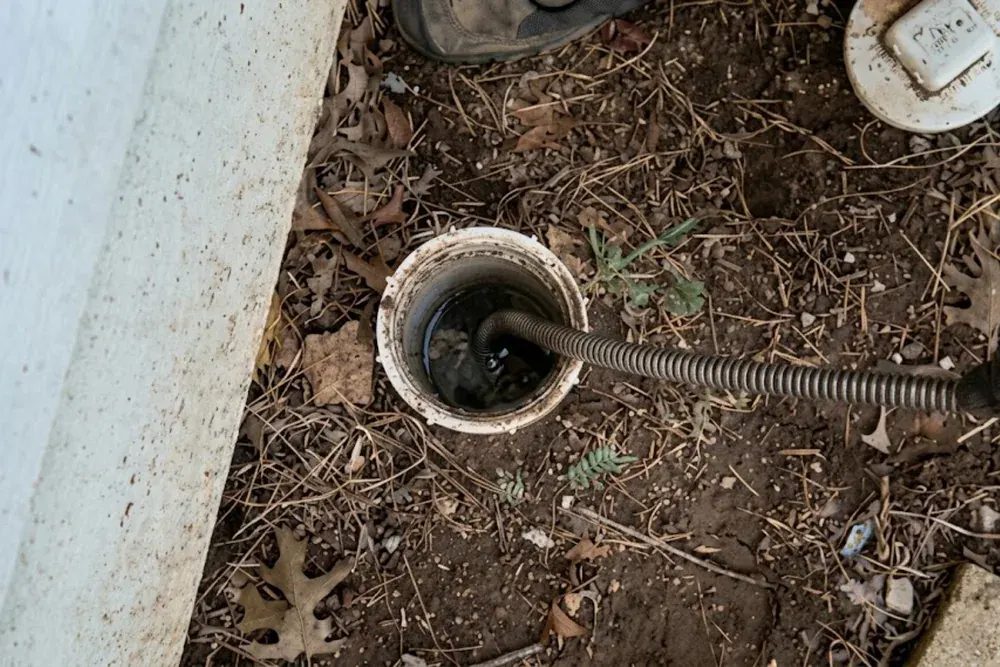
A main line stoppage looks different from a sink clog
The main sewer line is the single large pipe that carries everything from the house out to the street. Every branch from every bathroom, the kitchen and the laundry joins it. When it stops, the whole house shows it.
The telltale pattern is several fixtures failing at once, and the lowest ones failing worst. Water drains from the upstairs sink, then appears in the basement floor drain. A toilet flush bubbles in the shower. These are the signs that the problem lies in the main, not in a single fixture trap.
What homeowners usually notice first:
- Toilets, tubs and the washer drain slowly all at once.
- Water or foul smell comes up the basement floor drain.
- A toilet flush makes another fixture gurgle.
- The yard near the cleanout is wet or smells of sewage.
- A drain that cleared last month is slow again.
Wastewater rising in the house tonight
A completely blocked main means the house has stopped draining. Each flush, shower or load of laundry pushes more wastewater toward the lowest opening. That makes this a call for the after-hours line, not a job to hold until morning.
Tell dispatch whether water is only gurgling or already standing on the floor. We send a plumber on the same night for either, and the cleanout is usually the quickest way in.
Do this while you wait:
- Stop all water use, including the washer and dishwasher.
- Do not flush a toilet to see if it has cleared.
- Find the cleanout if you can. It is a capped pipe, often near where the main leaves the basement wall. Do not open it yourself, because standing wastewater can rush out.
- Keep pets, children and anyone with a health condition out of the wet area.
- If water has reached outlets or the panel, stay away and call 911 first.
Cleanouts: the door to your main line
A cleanout is a capped fitting on the sewer pipe that lets a plumber put a cable or camera straight into the main. Houses may have one inside near the foundation wall, one outdoors near the house, or none at all.
With a cleanout, the plumber reaches the main in minutes and works in a straight line toward the street. Without one, the plumber may have to pull a toilet to get in. That works, but it takes longer and is harder on the toilet seal. If your line has no cleanout, installing one is worth discussing, and the install is described under plumbing installation.
What a main line cleaning looks like
The aim is to open the pipe and then confirm that it stays open.
- Locate access. We find the cleanout or the best entry point and put down floor protection.
- Cable the main. A heavy-duty cable with a cutting head goes toward the street. It breaks up paper, grease or roots, and the plumber notes what comes back on the blades.
- Flush and test. Water is run through the line to confirm it flows freely and nothing is leaking at the cleanout.
- Recommend what the debris suggests. Roots on the cutter, scale flakes or a stuck point on the cable each lead to a different next step, and we tell you which.
Sewer line cleaning versus drain cleaning
Both clear a blockage, but they work on different parts of the plumbing system.
| Drain cleaning | Sewer line cleaning | |
|---|---|---|
| Pipe involved | A fixture drain or a branch inside the house | The main line from the house to the street |
| Typical symptom | One or two fixtures slow | Whole house slow, floor drain backing up |
| Equipment | Hand auger or small drum machine | Larger cable machine, camera, sometimes a jetter |
| Access point | A fixture trap or a branch cleanout | The main cleanout or a pulled toilet |
| Related page | See drain cleaning | This page |
If grease or scale is the cause, the plumber may suggest hydro jetting after the cable run.
Call now and say how many fixtures are affected. The main line may be the cause.
Roots in the main line
Roots are the most common reason a main line stops again and again. They find tiny gaps at pipe joints, enter looking for water, and grow into hairy mats. Toilet paper and grease catch in the mat and build the clog.
A cutting head on a cable removes the root mass and restores flow. The roots will regrow from the part still outside the pipe. How soon depends on the tree, the joint and the season, so we cannot give you a number of months. If roots keep returning, a camera shows how bad the entry point is, and sewer line repair may be the lasting fix.
Scheduled maintenance for lines that clog on a pattern
Some lines need regular attention. If your main has stopped more than once, a planned cleaning at an interval suited to the line costs less than another emergency. A camera pass after cleaning shows how clean the pipe is and helps you set that interval.
Old cast iron or clay pipes with rough walls, houses with large trees near the line, and homes with a belly in the pipe are the typical candidates. A kitchen that sends a lot of grease down the drain adds to the load. Not every house needs scheduled cleaning, and we will say so when the camera shows a clean, smooth line.
Milford: the town sewer and your side of the cleanout
The Town of Milford runs the sewer system and an advanced wastewater treatment facility that treats an average of more than 4 million gallons a day and discharges to the Charles River. Your main line connects to the town's pipe under or near the street.
A cable that clears your side but meets a blockage in the town main will get nowhere, because water backs up from the street. If your neighbors are also backing up, call the Milford Sewer Department at (508) 473-2054 as well as us. If it is just your house, the stoppage is on your side and we can clear it.
According to the Milford Sewer Department's own page, the town runs an advanced wastewater plant, which is why a blockage in the town main is a call to the department and a blockage in your lateral is yours.
Price factors for main line cleaning
The quote is a clear price given before work starts. It depends on:
Cleaning a clogged main is typically a maintenance expense. If the backup damaged floors or belongings, coverage often hinges on a water backup endorsement on your policy, so ask your agent before you file.
Ask for a price on your line at (508) 389-4045.
Questions about sewer line cleaning in Milford
Yes. Dispatch answers at any hour. A stopped main with wastewater in the house goes out as an emergency, and the plumber works from the cleanout to reopen the line on that visit in most cases.
It is a capped pipe fitting that gives access to the main line. It is often near the foundation wall inside the basement or just outside the house. If you cannot find one, tell dispatch and the plumber will look.
Only lines with a history of clogs, roots or rough old pipe need it. A camera after a cleaning shows the pipe condition and tells us whether a schedule makes sense. A clean, smooth line may not need one.
No. Cutting clears the roots inside the pipe, but they regrow if the opening at the joint remains. A repair or lining closes the entry point.
They use similar tools but work on different pipes. Drain cleaning clears fixtures and branch lines. Sewer line cleaning clears the main between the house and the street, with longer cable and often a camera.
If neighbors are backing up as well, call the Milford Sewer Department at (508) 473-2054. We can still confirm with a camera that your side is clear, which helps when you talk to the town.
A storm line is separate from the sewer and should never be tied into it. If a yard catch basin or buried downspout line is backing up, we can often clear it, though the cause is usually leaves, silt or roots. Street storm drains belong to the town, so call the Milford Sewer Department at (508) 473-2054 about those.
Not sure whether the problem is the whole main or just one drain? Describe it to dispatch at (508) 389-4045 and they will help you decide what to send.
If cleaning shows a deeper problem
When a cable hangs up in the same place twice, the pipe may be broken, so we suggest a sewer camera inspection before cleaning again. Water in a finished basement may also need a working sump pump, and homeowners in Holliston and nearby towns can reach the same line.